
Creators · Collection · Workshop
Inside Filon9's workshop: drawing a mine in pixels
Filon9 is one of the ten pseudonyms under which LiveGotchi drew the launch collection: not an independent artist, but a workshop and a line. Its theme is the mining sandbox — digging, matter, depth — and it holds eight creations: five creatures and three pieces of scenery. What makes its workshop notes worth reading is not what it draws, it is the list of what it refuses to draw.
A pseudonym, not an independent artist
The ten creators in the directory that make up the launch collection are pseudonyms under which LiveGotchi drew: they are not people, and none of them speaks in its own name. Each pseudonym carries a theme and a line, written at the top of its working file as workshop notes. The extracts quoted below come from there, and from nowhere else.
What makes those notes useful to a creator starting out on LiveGotchi is that they show the work done before the first pixel: picking a theme wide enough to carry eight creations, and narrow enough to look like no neighbour.
Geology, not a dungeon
Two other pseudonyms work in stone: one holds the dungeon, the other the night-time manor. Filon9 therefore had to stand apart from them without changing material. Its notes settle it by use rather than by colour:
"The lamp is not a corridor torch, it is a work tool" — in the original French, « La lampe n'est pas une torche de couloir, c'est un outil de travail ».
Nothing is built, nothing is haunted: it is work underground. The floor is not flagged, it is cut with a pick. The bat does not come down from the moon, it lets go of a cave ceiling. The same rule runs across all eight creations, and it is what makes a Filon9 recognisable without reading the signature.
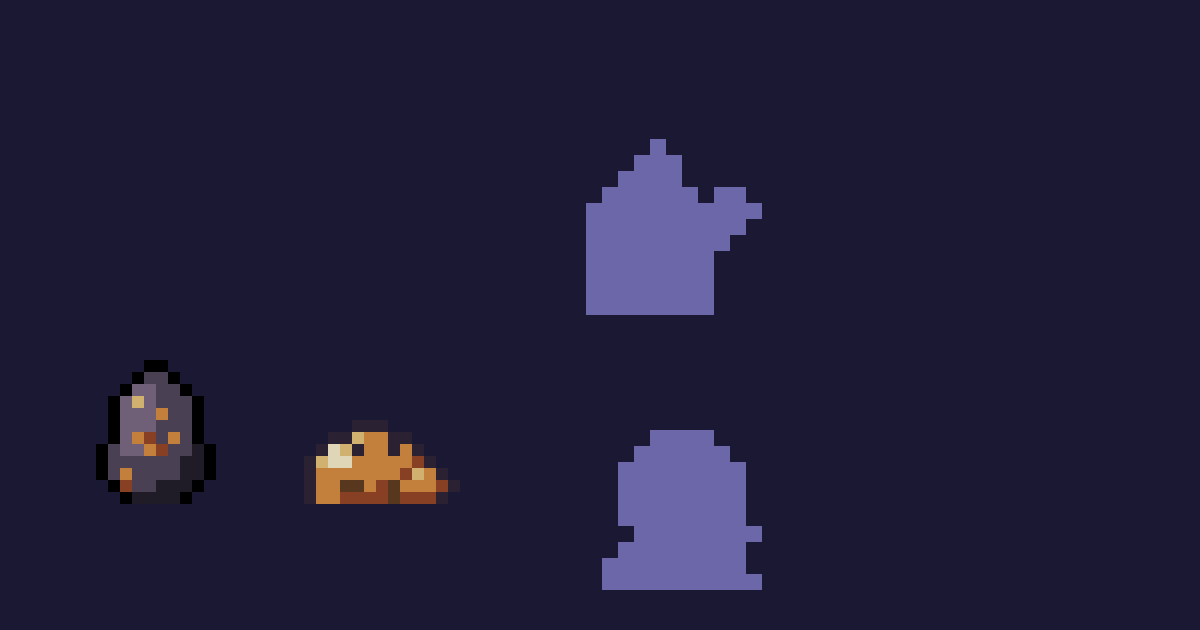
Gloub, by Filon9 — an amber clay puddle, wider than it is tall, with swallowed gravel showing through. Sixteen pixels across, two stages, around thirteen estimated hours on air: the creature of the first evenings.
The line it will not cross
The theme is slippery ground: a mining sandbox brings existing games to mind straight away. So the workshop notes set a test, applied to every board:
"with the name taken away, could a lawyer name the game?" — in the original French, « le nom retiré, un juriste pourrait-il nommer le jeu ? ».
Two guards are named explicitly, so they can be checked at the drawing stage: no big flying eye that comes at night, and no blue jelly fellow with a face. Instead, a cave bat — folded quadruped, two eyes, large leaf-shaped ears — and a clay puddle that does not bounce like a character but falls back like matter.
It is the same demand the Creation method makes of every creator: aim at the genre, never at the work. A genre belongs to everyone; a silhouette belongs to someone.
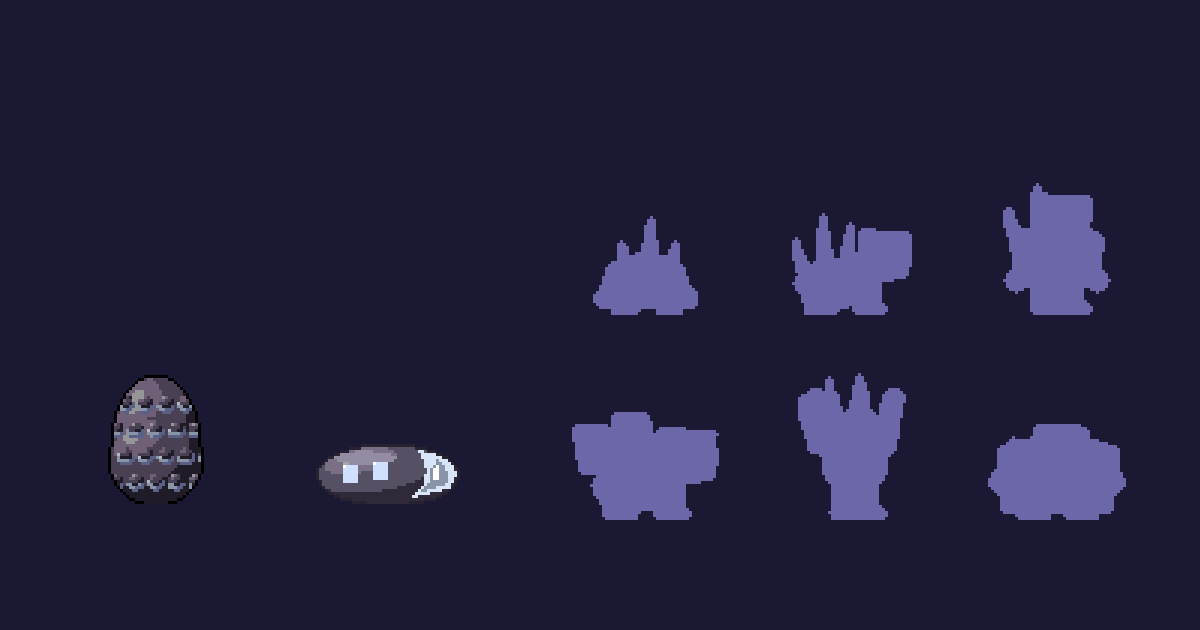
Gemmor, by Filon9 — a block of gangue on short legs, with a bunch of uneven prisms growing out of it. Sixty-four pixels across, five stages, around sixty-two estimated hours on air, and a fork decided by the ore: copper with flat blades, or amethyst with tall needles.
Names, built five different ways
The most unexpected part of the notes is about names. The fault they target is not the bad name, it is the repeated device:
"taken one by one the names pass, read one after another they give the machine away" — in the original French, « pris un par un les noms passent, lus à la suite ils trahissent la machine ».
So the five creatures are named in five distinct ways: an onomatopoeia (Gloub, the sound of a soft mass falling back), a French trade word taken as it is (Porion, the team leader at the bottom of a mine), a clipping (Chiro, from chiroptera, cut short), a short portmanteau (Gemmor, gem and gold) and a geology term (Karst, which names the cave itself).
The three pieces of scenery keep to a register of their own, on purpose: three concrete French objects you recognise without the page — Quinquet, Gravats, Paroi. And not one of the eight names replays a name already carried by a creature of the base registry.
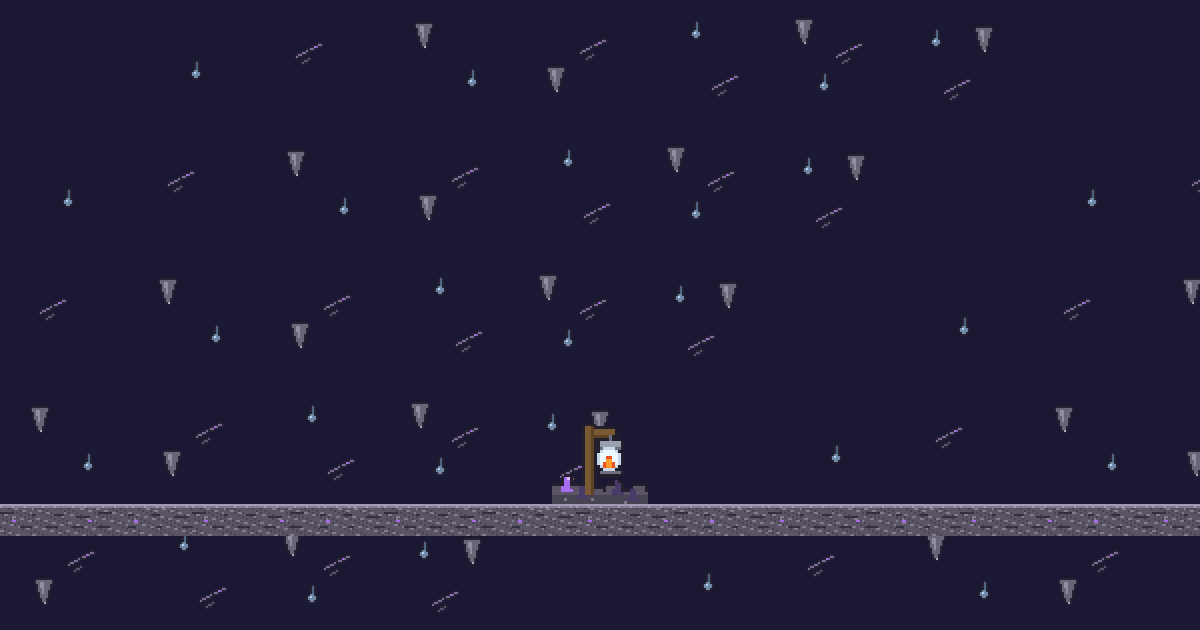
Quinquet, by Filon9 — a mine lamp hung from its wood, planted in a heap of spoil where the vein shows through. It is scenery that reacts: when chat talks fast, the flame grows from single to triple and the crystals in the heap light up one after another.
What the eight creations cover
Filon9 chose to make fewer creations and make them deeper: the room saved on the count went into branches, emotions and powers.
- Five creatures, from the simplest to the most worked: Gloub with two stages, Porion the miner with the lamp, Chiro the cave bat, Gemmor the crystal that learned to walk, and Karst the guardian you wake by digging too deep — eight stages, and twenty-three chat reaction keys.
- Three pieces of scenery that make a complete scene: one element that reacts, a floor cut with a pick, and a cave-wall paper sparse enough to let the creature show through.
A further series, Musique, is being prepared in the workshop on the same theme — techno seen as tooling that started to play. It is not published yet: none of it is visible in the directory today.
Frequently asked questions
Is Filon9 a real person?
No. It is one of the ten pseudonyms under which LiveGotchi drew the launch collection. Independent creators join the platform through the creators page and publish under their own name.
Where do the quotes in this article come from?
From workshop notes written at the top of Filon9's working file, in the LiveGotchi repository. They are notes of intent meant for drawing, not public statements, and they are quoted as they stand.
Can I take inspiration from an existing game for my own collection?
You can aim at the genre, never at the work: a mining sandbox, a dungeon, a manor belong to everyone; the monster, the character or the silhouette of one precise game belongs to someone. The Creation method sets out where the limit runs.
How many creations does it take to hold a theme?
There is no right number. Filon9 holds eight and put the room saved into the depth of its trees; other pseudonyms in the collection publish around fifteen, shorter ones. Both are there to read in the directory.